The Complete Rules of 7-a-Side Futsal
Whether you are a first-time player walking onto an artificial turf pitch or a seasoned organiser setting up a league, understanding the rules of 7-a-side futsal is essential. This guide covers everything — from court dimensions and team formations to fouls, restarts, and match flow — so you can step onto the pitch at PAKTB Grace Sports Centre in Thindigua with full confidence.
Court Dimensions and Layout
A standard 7-a-side pitch is approximately 50 metres long and 30 metres wide — about half the size of a regulation 11-a-side football pitch. The playing surface at PAKTB Grace Sports Centre is FIFA-quality artificial turf with clear line markings.
The key markings you will see on a 7-a-side pitch include:
- Centre circle: Where kick-offs take place. Opposing players must stay outside the circle until the ball is played.
- Penalty area (D-shaped or rectangular): The zone in front of each goal where the goalkeeper can handle the ball. Fouls committed by the defending team inside this area result in a penalty kick.
- Penalty spot: Located approximately 8 metres from the goal line, used for penalty kicks.
- Goal dimensions: Typically 5 metres wide and 2 metres high — smaller than full-sized goals (7.32m x 2.44m), which makes goalkeeping more manageable but also demands more precision from shooters.
- Corner arcs: Quarter circles at each corner of the pitch for corner kicks.
Team Composition
Each team fields seven players: one goalkeeper and six outfield players. Most venues, including PAKTB, allow rolling substitutions — you can swap players in and out at any time during play without stopping the match. This keeps the game fast and allows larger squads to rotate players and manage fitness.
A typical squad for a 7-a-side match has 9-10 players, giving you 2-3 substitutes to rotate through. For a casual session at PAKTB Grace Sports Centre, groups of 14 (7 per side) work perfectly, with larger groups of 16-20 rotating through on a timed basis.
Match Duration and Timing
Match duration varies depending on the format:
- Casual sessions: Most bookings at PAKTB are 60-minute blocks. Teams typically play continuous football, splitting the hour into two halves with a brief water break.
- League matches: Two halves of 25 minutes each with a 5-minute half-time break. Running clock (the clock does not stop for throw-ins or goal kicks).
- Tournament matches: Shorter formats — often two halves of 10-15 minutes — to fit multiple games into a single day.
Kick-Off
A coin toss determines which team kicks off first. The ball is placed on the centre spot, and the kicking team must play the ball forward. All opposing players must remain outside the centre circle until the ball is played. After a goal is scored, the team that conceded restarts from the centre.
Fouls and Free Kicks
The foul system in 7-a-side closely mirrors standard football:
- Direct free kick: Awarded for tripping, pushing, kicking, or holding an opponent, or for deliberate handball. The fouled team can shoot directly at goal from the free kick.
- Indirect free kick: Awarded for obstruction, dangerous play, or goalkeeper violations (holding the ball too long, receiving a deliberate back-pass). A goal cannot be scored directly — the ball must touch another player first.
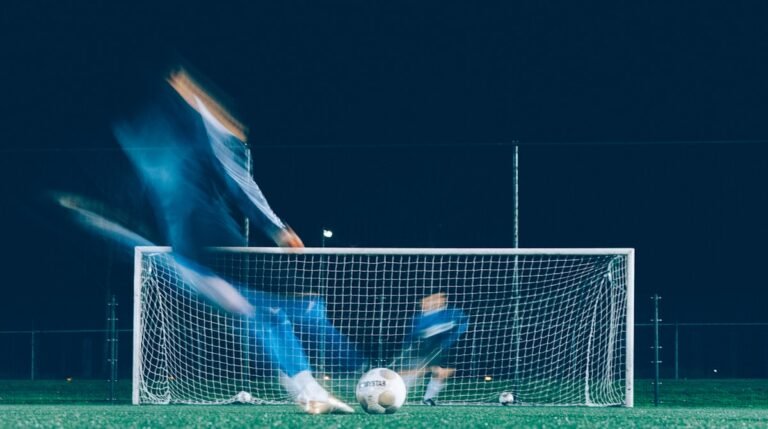
- Penalty kick: Awarded when a direct free kick foul is committed inside the penalty area by the defending team. The kick is taken from the penalty spot with only the goalkeeper defending.
Yellow and Red Cards
In organised league and tournament play, referees use the standard card system. A yellow card is a caution (typically for persistent fouling, unsporting behaviour, or dissent). Two yellows in one match equal a red card. A straight red card is shown for serious foul play, violent conduct, or abusive language. A red-carded player cannot be replaced — their team plays with six players for the remainder of the match.
In casual sessions at PAKTB, there is usually no referee, and teams self-officiate. Good sportsmanship and honesty keep the game flowing.
Restarts: Throw-Ins, Goal Kicks, and Corners
Throw-Ins
When the ball goes out of play over the sideline, the opposing team takes a throw-in. Standard throw-in rules apply: both feet on the ground, ball delivered from behind and over the head with both hands. Some 7-a-side leagues use kick-ins instead of throw-ins, which speeds up play significantly.
Goal Kicks
When the attacking team plays the ball over the goal line (without scoring), the defending goalkeeper takes a goal kick from inside the penalty area. In 7-a-side, the ball must leave the penalty area before another player can touch it.
Corner Kicks
When the defending team plays the ball over their own goal line, the attacking team takes a corner kick from the corner arc. Goals can be scored directly from corners.
Goalkeeper Rules
The goalkeeper has specific restrictions in 7-a-side futsal:
- Cannot hold the ball in their hands for more than four seconds (in formal futsal rules). In casual 7-a-side, this is relaxed but goalkeepers should still distribute quickly.
- Cannot pick up a deliberate back-pass played with a teammate’s feet. They can receive it with their feet, chest, or head — just not pick it up with their hands.
- Can come out of the penalty area and play as an outfield player, but cannot handle the ball outside the area.
How a Typical Session Flows at PAKTB
Here is what to expect when you book a 60-minute session at PAKTB Grace Sports Centre on Kiambu Road:
- Arrival (5 minutes before): Check in, change if needed, warm up on the pitch.
- Team selection: Captains pick teams, or pre-arranged teams take their sides.
- First half (25 minutes): Continuous play with rolling substitutions. Self-officiated.
- Half-time (5 minutes): Water break, team talks, substitute rotation.
- Second half (25 minutes): Play continues. Teams can switch ends if they choose.
- Cool-down (5 minutes): Final whistle, stretching, and clearing the pitch for the next group.
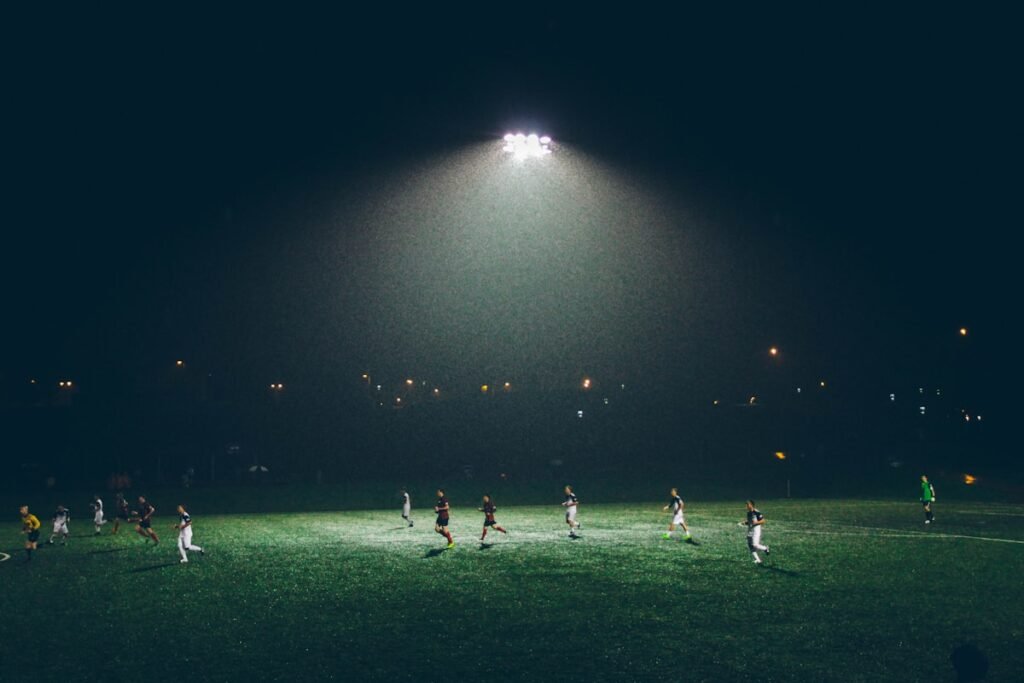
Sessions can be booked online and paid via M-PESA for maximum convenience. The venue provides floodlighting for evening games, so you can play after work — the most popular slots are 6pm to 9pm on weekdays.
Now that you know the rules, it is time to play. Book a pitch at PAKTB Grace Sports Centre and put this knowledge into action.